

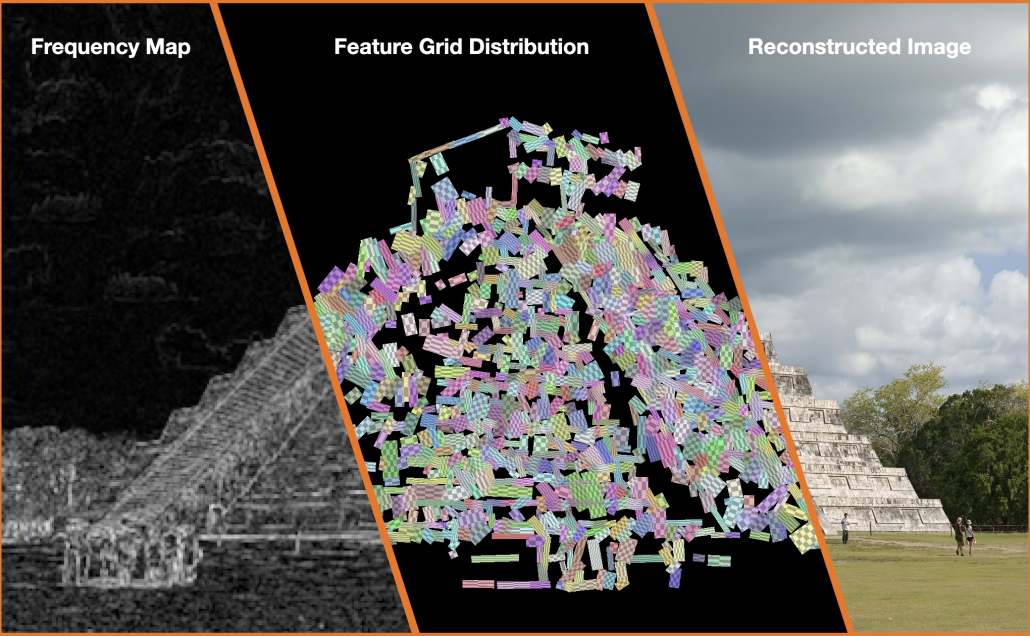
Frequency-Adaptive Gaussian Grids for Efficient Image Representation
Frequency-Adaptive Gaussian Grids for Efficient Image Representation
Anatolii Evdokimov, Stavros Diolatzis, Bingxuan Li, Akshay Jindal, Patsorn Sangkloy, Qi SunWACV 2027
Abstract
Neural representation has emerged as a powerful tool to mitigate the demand for increasingly higher-resolution images. However, a fundamental trade-off remains between structured (e.g., feature grids, which offer spatial consistency) and unstructured (e.g., 2D Gaussians, which adaptively capture local variances) representations. This choice significantly affects how well an algorithm represents an image. Here, we present Gaussian-Grid, a hybrid neural representation that adaptively integrates structured and unstructured primitives. By dynamically partitioning computation between 2D Gaussian distributions and their attached multi-resolution feature grids based on the local frequency content, Gaussian-Grid automatically optimizes its architecture to match the underlying complexity of the target signal. We evaluate our approach using high-resolution natural images and demonstrate its applications as GPU-native dataset storage, showing 1.24x – 2.14x decoding speed improvement and PCIe data traffic reduction of 23x – 176x over JPEG + ZIP data archiving. The results show that Gaussian-Grid maintains small memory footprints while achieving high reconstruction fidelity across a variety of datasets.
