

Perceptual Color Experience on Conventional and AR Displays across Color Gamut and Ambient Luminance
Perceptual Color Experience on Conventional and AR Displays across Color Gamut and Ambient Luminance
Yunxiang Zhang, Yuta Asano, Thomas Wan, Qi Sun, Alexandre ChapiroSIGGRAPh Asia 2026
Abstract
A display’s color gamut defines the range of colors it can reproduce and is a key factor of perceptual color experience. Modern displays increasingly support high dynamic range (HDR) and wide color gamut (WCG), enabling brighter and more vivid color reproduction. In practical viewing environments, however, ambient illumination often shrinks the effective gamut and degrades perceived color quality relative to the display’s native capability.
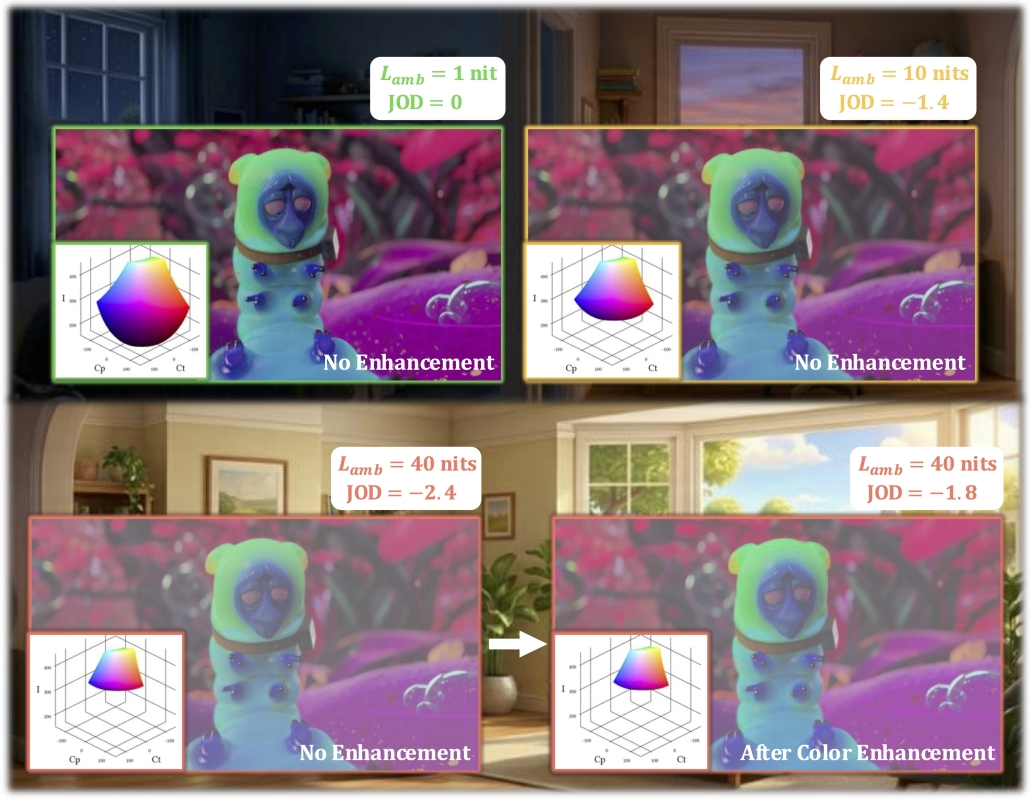
We study how color gamut, dynamic range, and ambient luminance jointly shape perceived color quality across conventional flat-panel and optical see-through augmented reality (OST-AR) displays. To this goal, we gather a WCG HDR video dataset and develop a display-simulation pipeline that emulates diverse display capabilities and ambient conditions. Using this framework, we conduct a direct-view user study to collect preference data and derive a perceptual model that predicts perceived color quality from these factors. A second study evaluates model generalization to OST-AR viewing conditions and examines the effect of background pattern. To mitigate ambient-induced color degradation, we introduce three color-enhancement algorithms and validate them in a third study. Our findings provide practical guidance for display-system design aimed at improving real-world color experience.
