

Gaze-Contingent Counter-Vection Noise for Cybersickness Reduction
Gaze-Contingent Counter-Vection Noise for Cybersickness Reduction
Colin Groth, Henry Kam, Piotr Didyk, Qi SunIEEE International Symposium on Mixed and Augmented Reality (ISMAR) 2026
Abstract
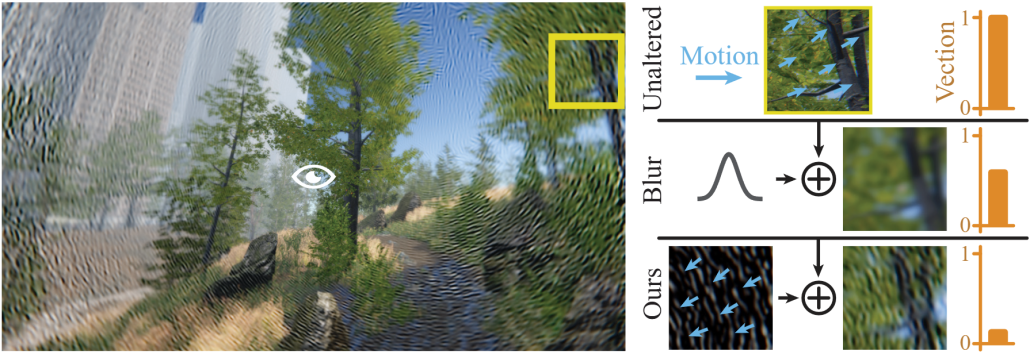
Cybersickness remains a common side effect of many immersive experiences, occurring particularly when fast, virtual-only movements induce high levels of optical flow. These visual movements can induce the perception of self-motion, denoted vection, which leads to a neurological sensory mismatch with the balance system, causing the body to react with sickness. Many techniques have been proposed to reduce cybersickness, aiming either to align the signals of both sensory systems or to suppress the motion perception of one system. One of the simplest, unobtrusive, and popular techniques is foveated blurring, which applies a gaze-contingent low-pass filter to the visual field. However, while the filtering removes high-frequency motion information responsible for high vection, the preserved low-frequency information of the content still carries significant motion cues. Therefore, the effectiveness of the approach varies depending on the visual content. In this paper, we introduce a novel method to enhance foveated blurring by integrating Gabor noise to actively counteract optical flow. Specifically, by leveraging the wave-like characteristics of Gabor functions, we dynamically shift their phase to generate localized motion signals. When these functions are oriented against the scene’s optical flow, they induce a “counter-vection” effect. Through spatial pooling, this conflicting motion information cancels out primary sickness-inducing stimuli without degrading the user’s overall motion perception. In our real-time implementation, the noise is fine-tuned to induce most counter-vection without being actively perceptible to the average user. In a naturalistic VR experiment, we validate the effectiveness of the approach and show that it can significantly improve the performance of regular foveated blurring.
